Physical Address
304 North Cardinal St.
Dorchester Center, MA 02124
Physical Address
304 North Cardinal St.
Dorchester Center, MA 02124
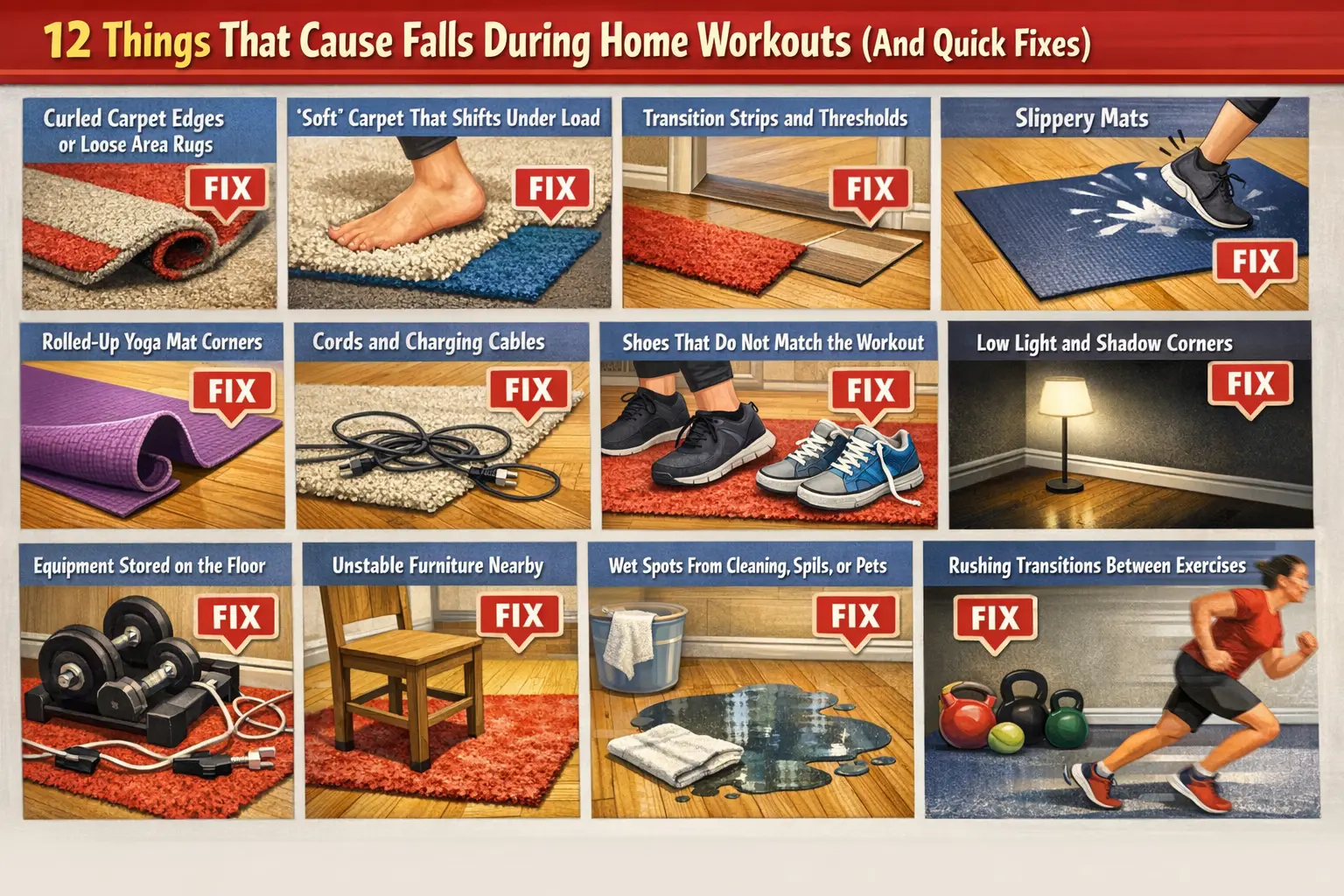
Most home workouts fail for annoying reasons: a mat that slips, a cord in the wrong place, a mat edge that curls up at the worst time. Falls happen quickly and often come from the setup, not the exercise.
Use this checklist to make your training space safer in about 15 minutes. It focuses on the real-world things that trip people up during squats, lunges, step-ups, jumping jacks, and speed circuits.
If you can’t take three steps forward, three steps back, and one step to each side without going around something, your space is too cluttered to practice.
If a fall occurs because unsafe carpeting or poor floor maintenance creates a hazard in a shared space, it helps to know what steps to take next. In Chicago, for example, slush and wet shoes often turn entryway mats into a slippery, uneven surface, especially in apartment hallways and older buildings. Illinois rules may differ from those in neighboring states, even when the danger appears the same.
Wisconsin and Indiana generally use a modified comparative negligence approach with a 51% bar, while a separate jurisdiction like California follows a pure comparative negligence approach, which can affect the significance of fault percentages. If you are in Chicago and the situation concerns carpet, this page of a Chicago Slip and Fall Rug Lawyer explains common causes and what tends to matter next.
Here are the common culprits, along with a one-minute solution for each.
Why it’s risky: Your toe catches when lunging back, pivoting, or even doing a quick reset between exercises.
Quick fix: Use carpet tape or a non-slip mat. If the mat still collapses, remove it from the workout area.
Why it’s risky: A thick mat compresses and your foot may tilt when you load one leg. This oscillation appears during split squats, step-ups and lateral work.
Quick fix: Place a firm mat or plywood/rubber platform under your main lifting area.
Why it’s risky: A small change in height can jam the front of your shoe when you’re moving quickly. Thresholds are sneaky during circuits because you’re breathing hard and taking shortcuts.
Quick fix: Keep your training area on one surface. If you have to cross a threshold, slow down and face it.
Why it’s risky: Sweat and a slick floor can cause your position to drift mid-repetition, especially during mountain climbers, burpees, or fast lunges.
Quick fix: Wipe the floor clean, then add a grippy mat or non-slip underlay.
Why it’s risky: A raised corner becomes a small ramp. Your foot lands on it, then slides.
Quick fix: First lay the mat flat for a few minutes. If it still curls, move to another mat or place it under a heavier top mat.
Why it’s risky: The cords catch your heel during quick exercises, step-overs, or even when grabbing water between sets.
Quick fix: Route cords along walls and not across walkways. Tie or tape them where they cross an open space.
Why it’s risky: Cushy running shoes may feel unstable during lifting and lateral movements. Socks placed on smooth floors may slip. Shoes with worn treads may lose traction on tile or hardwood.
Quick fix: For weight training days, use flat, stable shoes or go barefoot if your surface is clean and safe. For cardio, use sneakers with traction.
Why it’s risky: You miss the little things: a dumbbell, a water bottle, a toy, a resistance band. The shadows hide the disorder.
Quick fix: Turn on brighter overhead lighting or add a floor-directed lamp.
Why it’s risky: Belts, handles and small objects roll or move. Walking on it can quickly twist your ankle.
Quick fix: Use a trash can, wall hook or shelf. Ground storage belongs outside the training course.
Why it’s risky: You reach for a chair or table for balance, and it moves. This can turn a small wobble into a complete fall.
Quick fix: If you use a stand, use something heavy and non-tilting, or place it against a wall.
Why it’s risky: A small wet spot can turn a normal step into a skid. A wet carpet may be sticky in one area and slippery in another.
Quick fix: Do a quick “dry sweep” with a towel before training. If the carpet has been recently cleaned, give it time to dry completely.
Why it’s risky: Many slip-ups happen between sets, not during the set. You turn quickly, grab weights, or step backwards without checking the ground.
Quick fix: Build a five-second reset into the circuits: stand up straight, breathe once, look down, then move.
This warm-up is all about foot control and placement. It also gives you a quick overview of how your ankles and hips currently feel.
Keep it smooth. If you feel shaky, slow down until each repetition feels the same. Your goal is consistency.
First, check for head impact, sharp pain, numbness or dizziness. If something seems serious, see a doctor. If you hit your head, feel confused, or your symptoms get worse, don’t “shake it.”
Once safety comes first, it’s a good idea to document the cause of the fall, especially if it occurred in a shared area or somewhere you don’t control. THE CDC Fall Prevention Materials Also include ideas for practical checklists that can help you spot hazards before they become a problem.
A basic checklist after a fall:
After correcting the obvious dangers, the next step is to improve balance and single-leg control so that minor trips remain minimal. Two or three short sessions per week can make your foot more reliable in daily life and training.
A good place to start is a focused balance routine that you can progress from week to week. Our guide to balance training exercises is a solid option for building stability with simple movements you can do at home.
Conclusion : Clear your path, secure your surfaces and practice control before increasing speed. Your workouts improve when your footing is reliable.


