Physical Address
304 North Cardinal St.
Dorchester Center, MA 02124
Physical Address
304 North Cardinal St.
Dorchester Center, MA 02124
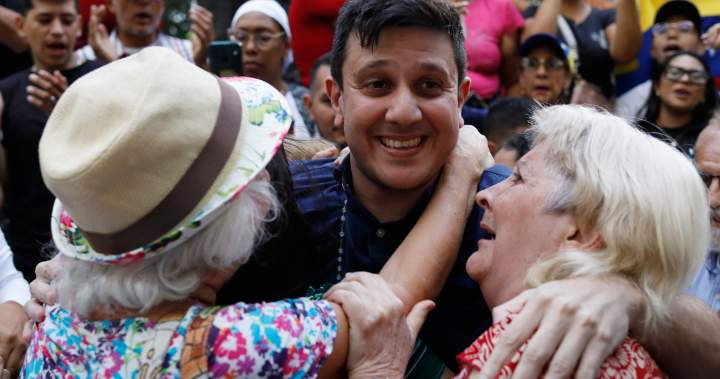
The Venezuelan government on Sunday released several prominent opposition members, including one of Nobel Peace Prize laureate Maria Corina Machado’s closest allies, from prison after lengthy detentions for political reasons.
Their releases come as the government of interim President Delcy Rodríguez faces growing pressure to free hundreds of people whose detention months or years ago was linked to their political beliefs. They also follow a visit to Venezuela representatives of the United Nations High Commissioner for Human Rights.
“Today we are liberated,” Juan Pablo Guanipa, Machado ally and former governor, said in a video posted on X. “There is much to discuss about the present and future of Venezuela, always with the truth at the forefront.”
Guanipa, who spent more than eight months in detention, was released from a detention center in the capital, Caracas. An armored vehicle and officers appeared behind him in the video he released.
Venezuela-based prisoners’ rights group Foro Penal confirmed the release of at least 30 people on Sunday.
Besides Guanipa, Machado’s political organization said several of its members were among those released, including Maria Oropeza, who livestreamed her arrest by military intelligence agents as they broke into her home with a crowbar. Machado’s lawyer, Perkins Rocha, was also released.

Get the day’s top news, politics, business and current affairs headlines delivered to your inbox once a day.
“Let’s go for the freedom of Venezuela!” » Machado posted on X.
Guanipa was arrested in late May and accused by Interior Minister Diosdado Cabello of participating in an alleged “terrorist group” plotting to boycott that month’s legislative elections. Guanipa’s brother, Tomás, rejected the accusation and said the arrest was aimed at suppressing dissent.
“Thinking differently cannot be criminalized in Venezuela and today Juan Pablo Guanipa is a prisoner of conscience of this regime,” Tomás Guanipa said after his arrest. “He has the right to think as he thinks, the right to defend his ideas and the right to be treated according to a constitution which is not applied today. »
Rodríguez was sworn in as Venezuela’s interim president after then-President Nicolás Maduro was captured in Caracas by the U.S. military last month.
His government announced on January 8 that it would release a significant number of prisoners – a central demand of the country’s opposition and human rights organizations with support from the United States – but families and rights groups have criticized authorities for the slow pace of releases.
The National Assembly, controlled by the ruling party, this week began debating an amnesty bill that could lead to the release of hundreds of prisoners. The opposition and non-governmental organizations responded with cautious optimism and by suggesting and demanding more information on the content of the proposal.
National Assembly President Jorge Rodríguez posted a video on Instagram on Friday showing him outside a Caracas detention center and saying that “everyone” would be released next week at the latest, once the amnesty plan is approved.
Delcy Rodríguez and Volker Türk, the United Nations High Commissioner for Human Rights, spoke by telephone in late January. His spokeswoman, Ravina Shamdasani, said in a statement that he “offered our support to help Venezuela work on a road map for dialogue and reconciliation in which human rights should be at the center” and that he then “deployed a team” to the South American country.
—Associated Press writer Jamey Keaten in Geneva contributed to this report.
© 2026 The Canadian Press


